What I built, what failed, and the research questions that followed.
Jeremy Junming Wei
Mathematics–Computer Science University of California, San Diego
I worked on HOPE as one of four student developers. My primary work covered OptiTrack calibration and
rigid-body tracking, reflective-marker ball design, and three manually authored, predefined serve
motions. I also contributed to physical-trial analysis and deployment; the learned return policy and
end-to-end system were team efforts.
Three consecutive system returnsBalls manually introduced by Jeremy · late-stage laboratory trial
01 / Project context
A full physical loop, not an isolated model.
HOPE is an open platform for autonomous humanoid table tennis. Its system-level structure follows a
perceive–predict–plan–strike pipeline. Ball and robot observations were converted into
state and trajectory information, used to predict future ball motion, select a desired contact, and
command the humanoid.
The public HOPE team repository provides a usable baseline prototype spanning
training, simulation, planning, motion-capture integration, and physical deployment on the AgiBot A3.
Motion capture provides timestamped 3D ball positions and robot base poses. Joint encoders provide joint angles and velocities. During play, racket pose is calculated from the base pose and joint angles using forward kinematics.
Motion capture
300–360 Hz
Racket pose
Forward kinematics
02 / Method
State estimation / trajectory history
A sliding window retains the 31 most recent ball observations by default. Independent least-squares quadratic fits to x(t), y(t), and z(t) estimate the ball’s position; their derivatives give its velocity. The history resets around detected bounces or sudden velocity changes.
Default window
31 observations
Time span
≈ 100 ms at 300 Hz
03 / Method
Ball-trajectory prediction
Starting from the fitted position and velocity, numerical integration propagates a gravity and quadratic air-drag model, including table-bounce restitution. It predicts the ball’s position, velocity, and arrival time at the selected hitting plane.
Integration step
1 ms
Flight model
Gravity + quadratic drag
04 / Method
Planning / control policy
The planner solves for the outgoing ball velocity needed to reach the desired landing point, then uses a racket–ball collision model to determine racket velocity and face orientation. The predicted interception provides the contact position and timing. The whole-body policy combines its strike-target inputs with robot observations to produce a 31-dimensional action vector.
Policy rate
50 Hz
Action vector
31 dimensions
05 / Method
Humanoid execution
Policy actions are converted into joint-position targets. Low-level PD control tracks these targets using position and velocity feedback, coordinating the arms, waist, and legs.
Command
Joint-position targets
Feedback control
PD tracking
06 / Method
Ball interaction
Racket contact redirects the ball. Subsequent motion-capture observations update the estimated ball state and support the next prediction cycle.
Physical event
Racket–ball contact
Feedback
New ball observations
02 / Individual scope
My Contributions
My primary implementation work appears first; contributing and team-support roles are labeled separately.
01
Primary contribution · Perception infrastructure
Motion Capture and Tracking
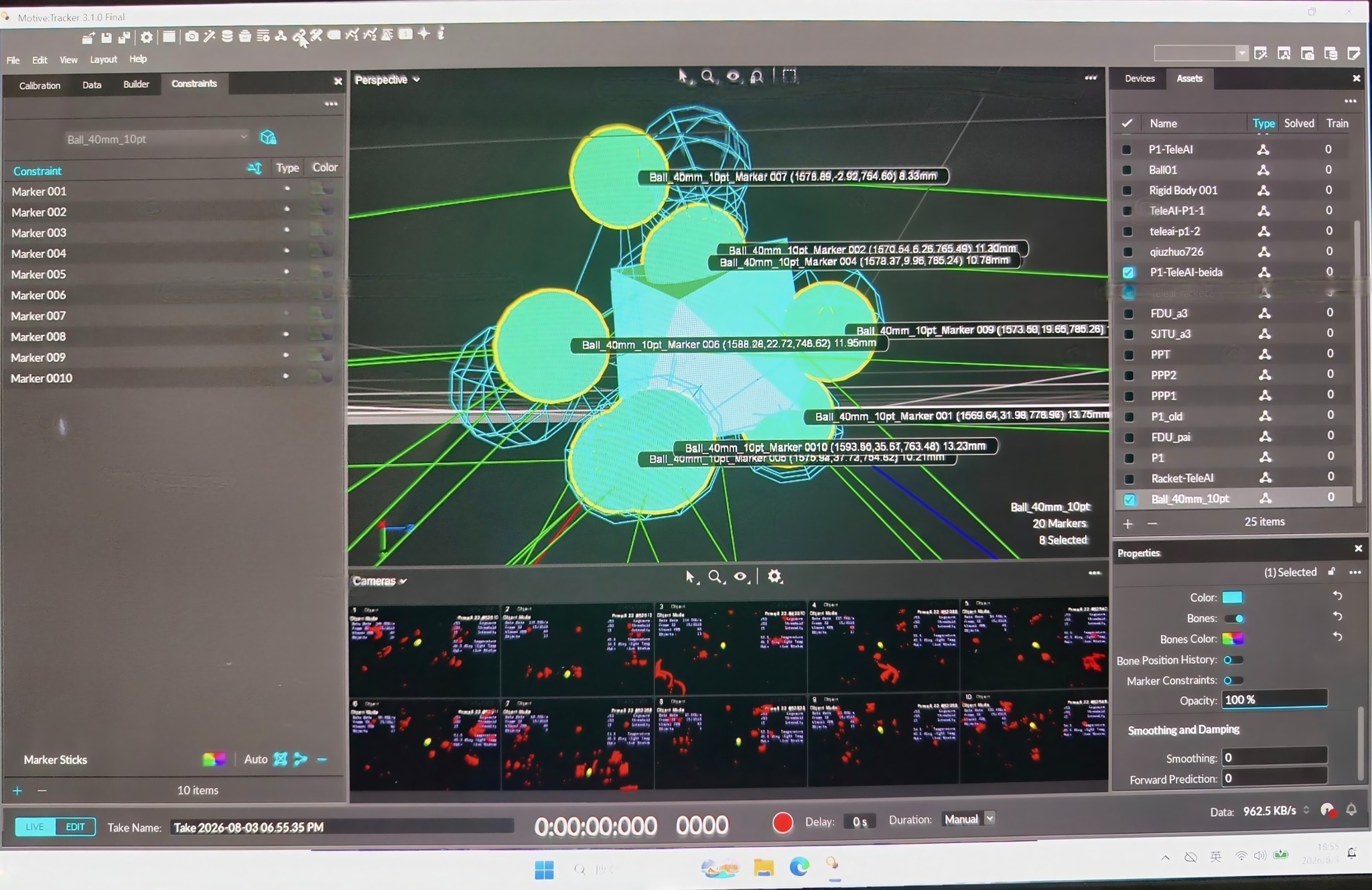
Maintained the OptiTrack calibration and tracking environment and created or updated rigid-body models.
Reconfigured camera placement and height, then recalibrated and validated the system when detection quality degraded.
Diagnosed tracking and calibration failures during training, testing, and competition.
What the image shows
OptiTrack detects the ball’s ten reflective markers and identifies their relative positions within the rigid-body model.
View larger ↗Tracking evidenceTen-marker rigid-body model
02
Primary contribution · Physical sensing design
Reflective Marker Design
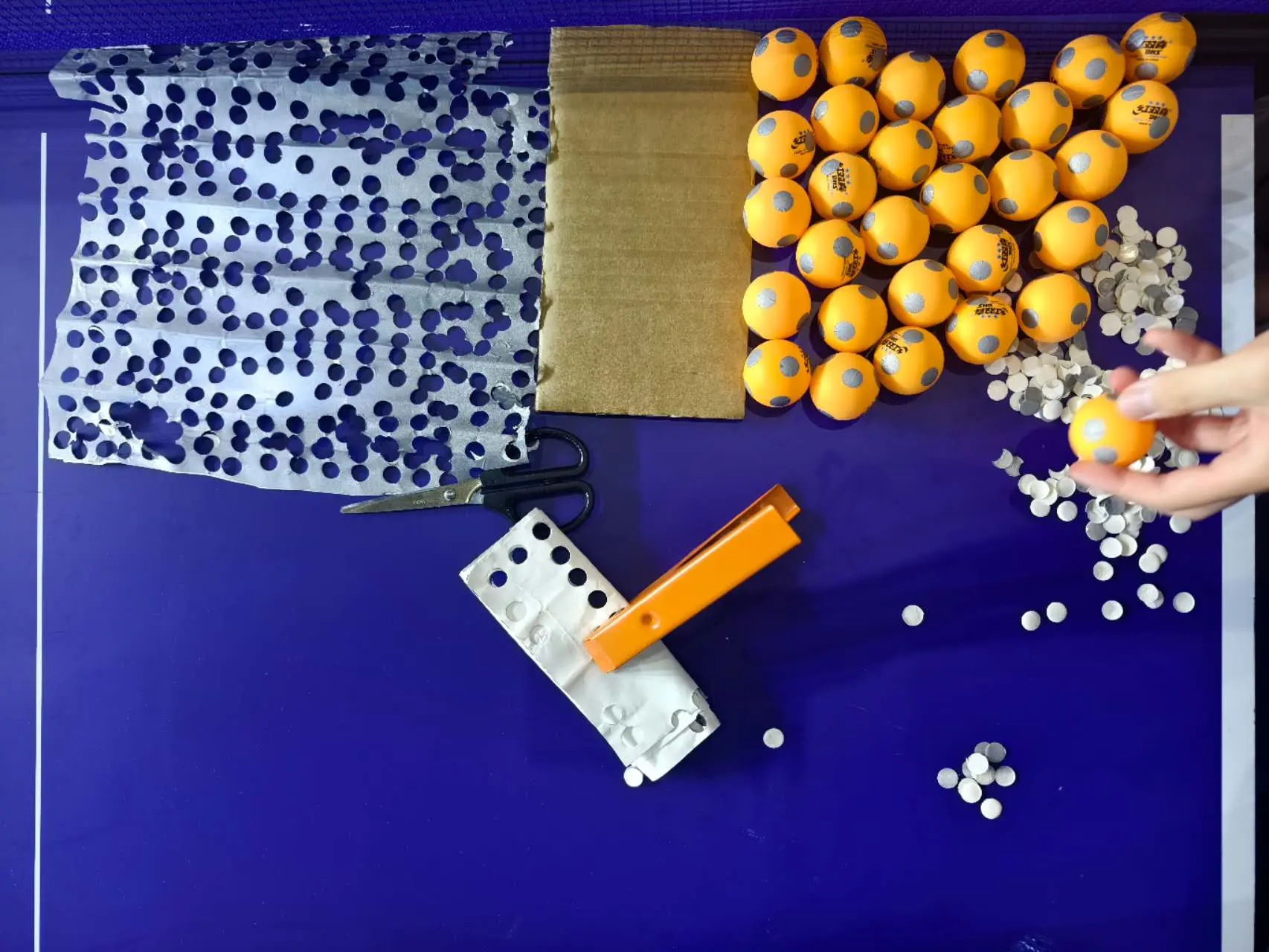
Designed six formal marker-layout variants and fabricated more than 50 marked balls across formal and exploratory configurations.
Created an OptiTrack rigid body for each candidate and evaluated tracking dropouts during live rallies with teammates, including high balls, smashes, and spin.
Selected layouts based on continuity of position and orientation tracking; helped fabricate and prepare standardized eight-marker balls for distribution to participating university teams.
Design trade-off
The eight-marker ball was the standardized version prepared for participating
teams; my later ten-marker design used smaller reflective patches.
I initially expected eight larger markers to improve detection; ten equally large patches left
too little spacing for reliable identification. The larger patches wrinkled on the ball even
after trimming, and I observed changes in contact and bounce during live rallies and ball-toss
tests. I chose ten smaller markers to balance tracking reliability with bounce behavior.
Developed three manually authored serve motions in MuJoCo and transferred them to the physical
humanoid. The first supported qualification and later served as a backup; the other two were used
primarily in competition.
For one motion, compared 100 racket-orientation and contact-speed pairs under limited
perturbations, using target landing error as the selection criterion.
Adapted two human serve references into robot-feasible joint-space trajectories; all three motions
were predefined rather than online-adaptive.
What testing showed
Hardware testing showed that nominally accurate settings still needed margin for net clearance
and deviations in contact position and speed. PD-controlled execution did not always fully
realize the intended racket motion.
Reviewed prior work, contributed to discussions about return-policy design, and analyzed recorded
robot trials for missed strikes, instability, and recovery failures to identify priorities for
subsequent testing.
Helped standardize the testing environment; measured reference geometry and marker spacing;
installed grippers and robot-mounted markers; supported networking and debugging workflows; and
coordinated hardware and experimental-material logistics.
03 / Selected visual evidence
Field Testing and Public Demonstrations
From physical prototypes to venue testing, public showcases, and competition.
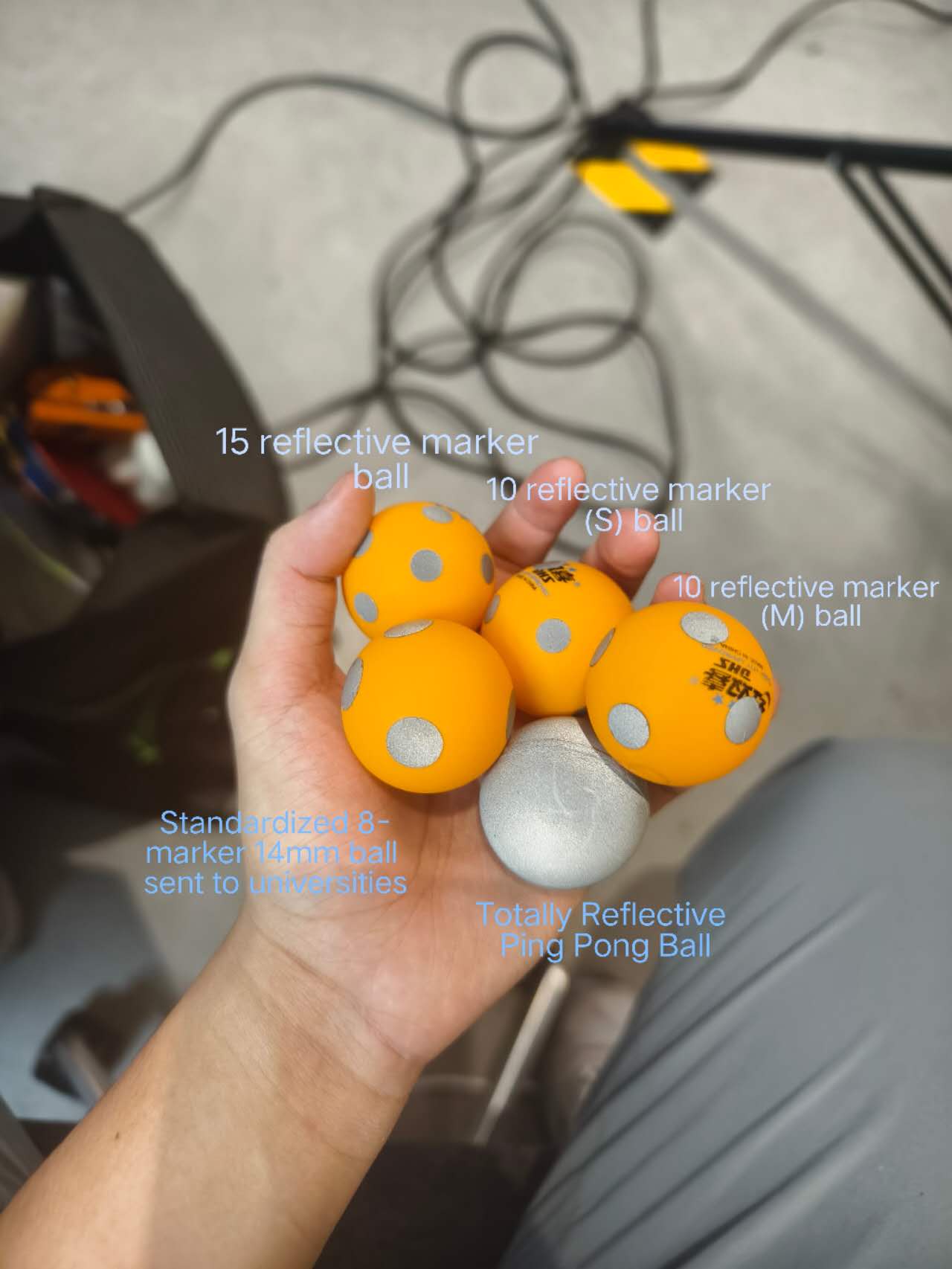
View larger ↗Design iterationsFive ball variants, side by side
Five physical prototypes from a broader process of six formal marker layouts and more than 50 fabricated balls.
The photo shows a 15-marker layout, two 10-marker versions with different patch sizes, the standardized eight-marker ball, and a fully reflective variant.
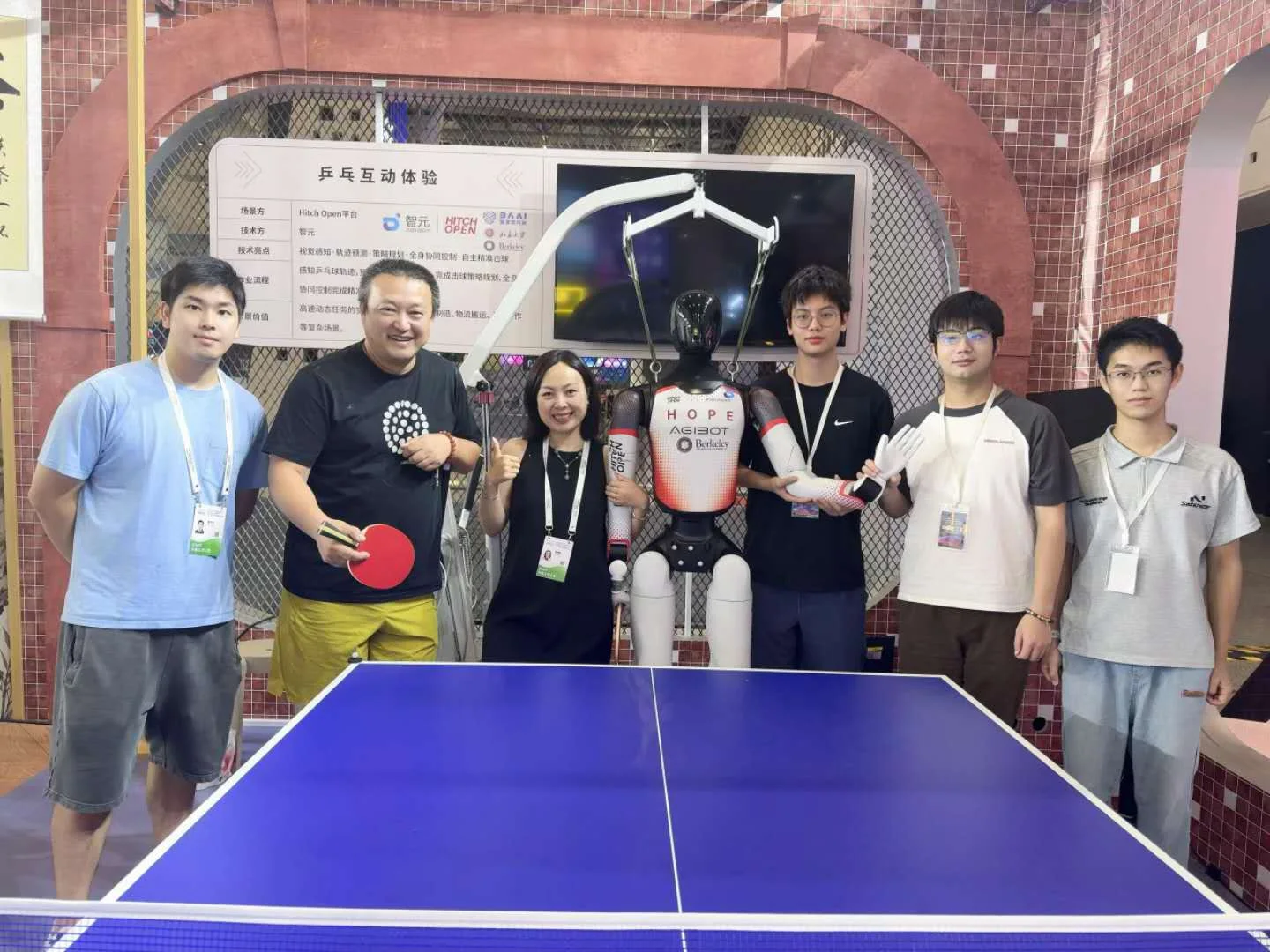
Official showcase of the physical HOPE system before its later competition deployment in Beijing.
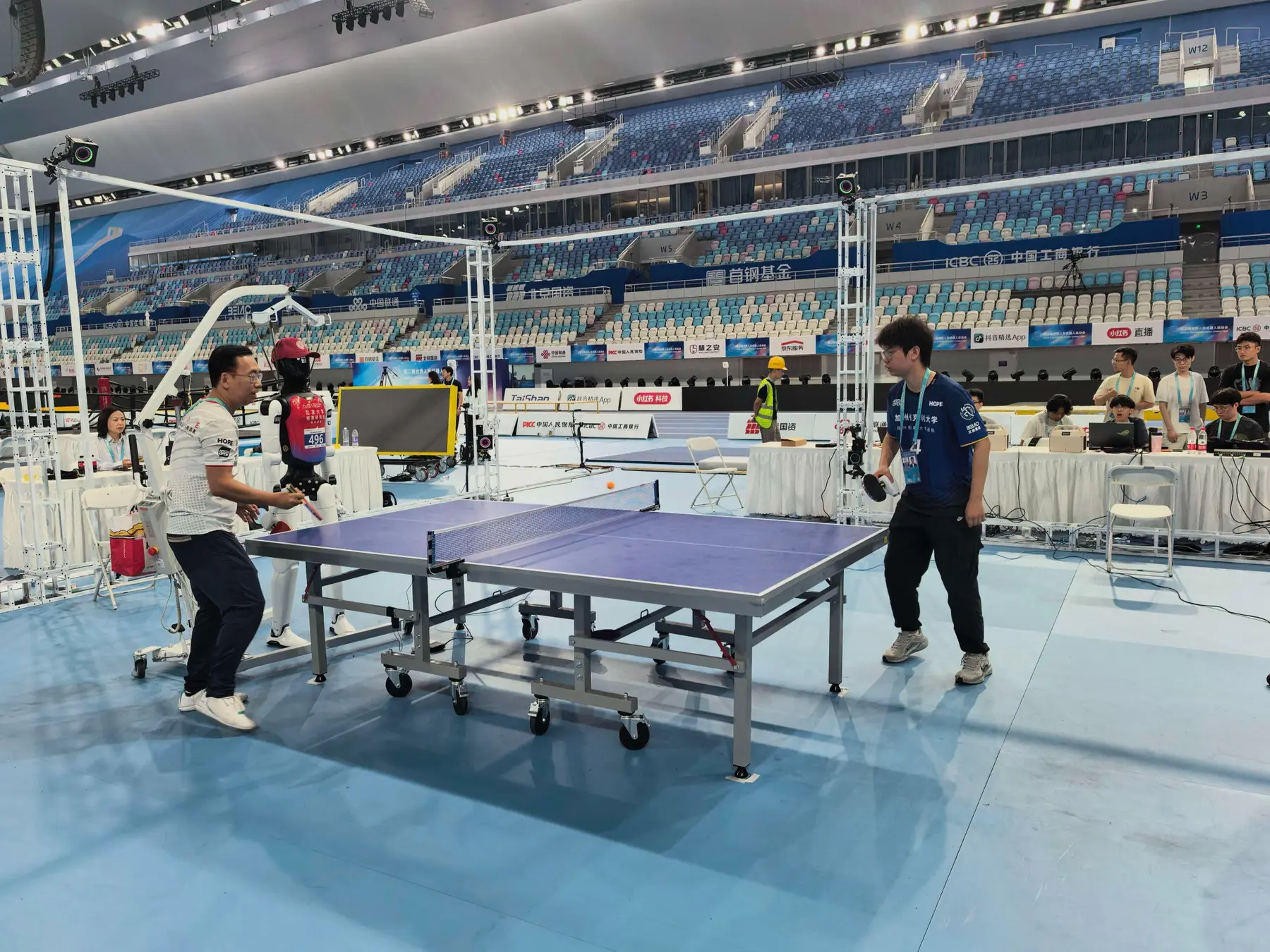
View larger ↗On-site validationTesting marked-ball tracking at the competition venue
Jeremy and a professor rallied with the finalized reflective-marker ball to evaluate whether the venue
OptiTrack setup could retain a usable track during live exchanges.
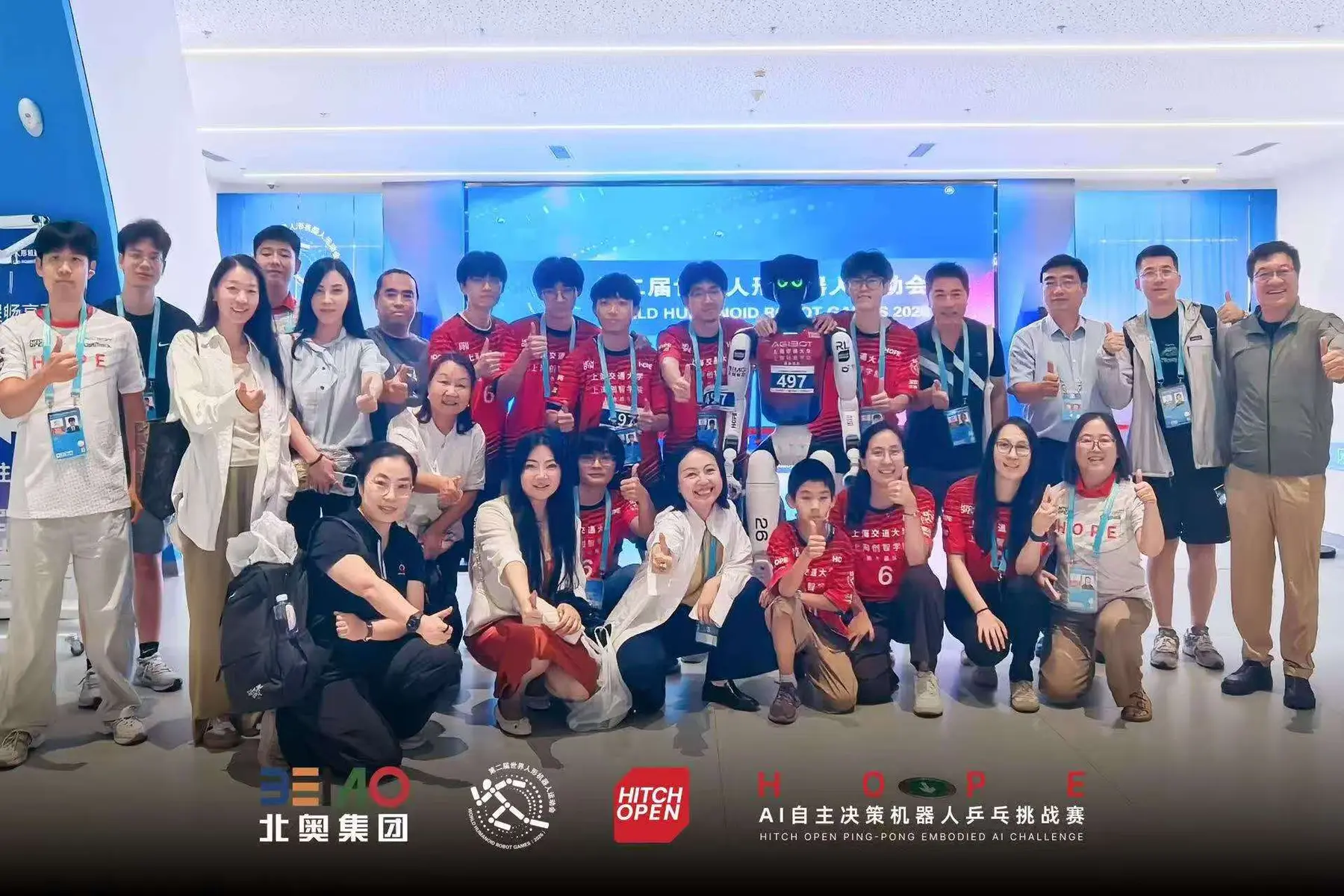
View larger ↗Official competitionHOPE at the Second World Humanoid Robot Games
Official HITCH OPEN competition photograph at the Beijing venue · August 2026.
Additional evidenceEarlier integration clip
Early integrationManually introduced ball test
A professor manually introduces the ball while the team evaluates the physical setup, documenting
integration before the full serve mechanism was in place.
04 / Technical problems
What the physical system made visible.
These deployment failures motivate the research questions that follow.
Problem 01
Dynamic Interception
A plausible trajectory is not yet a successful contact event.
Serving and returning both depended on a narrow temporal and spatial contact window. For returning,
recent motion-capture observations were used to predict the ball’s future trajectory and determine a
desired hitting position and time. In practice, nominal trajectory accuracy alone did not guarantee
physical interception.
At the competition venue, the robot executed one of the predefined serve motions I developed
but did not contact the ball. A communication or timing issue was suspected; no logs are available
to confirm the cause. Successful physical serves had already been achieved during laboratory
testing, but those trials were not recorded.
This experience led me toward a central question: how should state estimation and prediction
support downstream robotic decisions when uncertainty can enter at multiple points in the loop?
Problem 02
Whole-Body Stability
Reaching the ball and remaining recoverable were inseparable objectives.
Whole-body balance remained a major challenge. The team experimented with whole-body imitation and
later emphasized upper-body tracking while allowing greater freedom in the lower body. Lateral
movement could still trigger increasingly aggressive corrective motions, instability, and eventual
falls.
Physical failure casePost-contact loss of balance
After executing the return, the robot exhibits large trunk sway and repeated corrective steps,
culminating in a safety-supported near-fall. The trial illustrates how task-level contact can
still leave the whole-body state difficult to recover.
Jeremy contributed through physical-trial analysis and balance- and recovery-related debugging;
the return controller was a team effort.
The failures exposed the coupling among task execution, balance, recovery, and whole-body control:
an action can be locally useful for contact while making the next state harder to control.
05 / Emerging research direction
Questions I Want to Explore
HOPE began as a systems and deployment experience. Failures observed in physical trials raised a
connected set of questions about how robots convert uncertain observations into timely, physically
feasible actions.
01
How can a robot estimate a fast-moving object’s evolving state—and predict its future trajectory—from imperfect observations while representing uncertainty?
02
How should uncertainty in those estimates shape the selection and timing of a physically feasible interception action?
03
How can real-world trials distinguish errors in sensing and prediction from those introduced by planning and execution—and use that attribution to improve the full interaction loop?
Research direction
The challenges I encountered in HOPE shaped my current interests in
state estimation, tracking and prediction, and
probabilistic modeling, particularly how they inform planning and control in
dynamic robotic systems.
These interests are a starting point, not a fixed boundary. I am also open to related projects
in perception, robot learning, planning, and control, and to joining research groups approaching
these problems from different perspectives.